
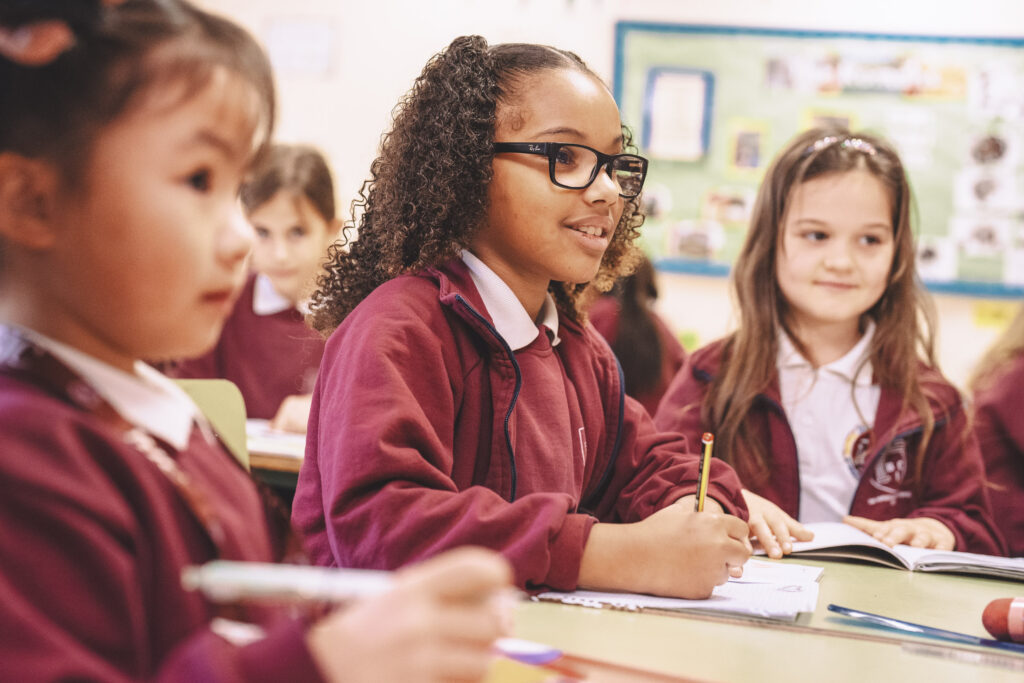
By seven months old, babies raised in bilingual households already show a measurable advantage in adapting to unexpected change. That finding comes from research published in the NIH’s PubMed Central, and it sets the tone for everything that follows: the bilingual brain does not develop its advantages at school age. It starts building them in the crib.
For parents on the Costa del Sol choosing where to educate their children, that matters. At The Benalmádena International College, more than 300 students from 33 nationalities study the British Curriculum through English-medium instruction from Preschool through Sixth Form. Language is not a subject timetabled on Tuesdays and Thursdays. It is the medium through which everything else is learned.
Understanding the importance of bilingualism in education helps parents look past the obvious communication benefits and into the cognitive science underneath.
What the Bilingual Brain Actually Does Differently
A common assumption is that managing two languages creates mental clutter. The research has spent decades disproving this.
When a bilingual person speaks or listens, both languages are active at the same time. The brain does not switch one off and run the other. Instead, it continuously manages both systems, selecting the appropriate one for the moment and suppressing the competing signals. That management process is cognitively demanding. Over time, it produces measurable changes in the brain.
The practical outcomes show up across several areas: attention control, working memory, processing speed, cognitive flexibility, and emotional regulation. None of these are language skills. They are general cognitive capacities that the bilingual brain develops as a byproduct of handling two languages every day.
Attention, Focus, and Executive Function
Executive function is the set of mental processes governing planning, focus, impulse control, and mental flexibility. In tasks that test selective attention — concentrating on relevant information while filtering out distractions — bilingual children consistently outperform monolingual peers.
The mechanism is well understood. Keeping two language systems active requires the brain to resolve constant low-level conflict, selecting the right word, suppressing the wrong one, adjusting for context. That repeated resolution exercises the same neural systems underlying executive function. The workout is ongoing, not occasional.
For students following the British Curriculum at The Benalmádena International College, this matters in practical terms. The curriculum asks students to manage complex material across multiple subjects simultaneously. Bilingual learners arrive with executive function capacities already developed beyond the baseline.

Working Memory and Processing Speed
Working memory is the brain’s scratch pad: the system that holds information in play while you act on it. Reading a sentence, following a spoken explanation, tracking variables in a maths problem — all of these depend on working memory.
Bilingual individuals consistently show stronger working memory performance. The reason is structural: managing two sets of vocabulary, grammar patterns, and phonological rules in regular use exercises exactly the cognitive system that working memory depends on. The more that system is used, the more efficient it becomes.
For children, this advantage compounds across years of schooling. Better working memory supports faster reading comprehension, more efficient problem-solving, and stronger performance in subjects that require students to hold multiple ideas in mind at once.
Cognitive Flexibility — The Bilingual Advantage in Problem-Solving
Cognitive flexibility is the ability to shift mental strategies when circumstances change. It is perhaps the most consistently documented advantage in bilingual children.
A systematic review published in Frontiers in Psychology, analysing dozens of studies on bilingualism and executive function in children, found robust bilingual advantages specifically in task-switching and inhibitory control. These are the mental skills that allow a person to stop doing one thing and shift efficiently to another — exactly what problem-solving demands when an initial approach fails.
Bilingual children try alternative strategies more readily. They are less likely to persist with an approach that is not working. In competitive academic environments, that flexibility is a genuine advantage.
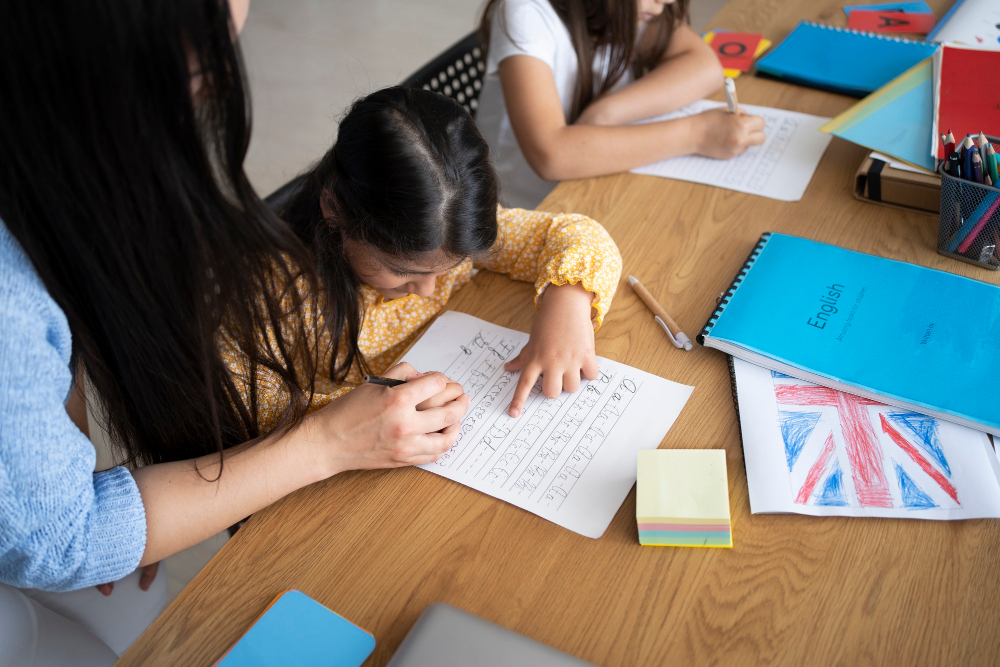
The Preschool stage at The Benalmádena International College begins building this foundation from age three. Children move between English and Spanish naturally, across peer groups from different countries, with teachers from different backgrounds. The cognitive load of navigating that environment early produces exactly the kind of flexible thinking the research documents.
By Primary level, that flexibility is already in place, and students are ready to apply it to structured academic challenge. The EYFS and Primary methodology at The BIC is built around precisely this progressive development — each stage building on what the previous one has established.
The Emotional and Psychological Side
Cognitive benefits tend to dominate bilingualism research. The psychological effects on children deserve equal attention.
Self-Esteem and Identity
Becoming capable in two languages is a real achievement. Children know the difference between being told they are doing well and actually being able to communicate with someone in their language. The confidence that comes from genuine competence is more durable than praise.
At The Benalmádena International College, speaking more than one language is not remarkable. Thirty-three nationalities in a single school means the majority of students are navigating more than one cultural and linguistic world simultaneously. Children build identity partly through their peer environment, and a multicultural community normalises what in other schools might be seen as unusual or difficult.
The cultural exchange students experience at The BIC feeds directly into this sense of belonging across communities rather than within just one.
Emotional Regulation
Research on what is called the “foreign language effect” has found that reasoning in a second language tends to reduce emotional bias. The psychological distance of operating outside one’s native tongue appears to engage more deliberate, less reactive cognitive processing.
In children, this supports emotional regulation — the ability to manage responses to situations rather than react immediately. Combined with active learning approaches that put students in collaborative, problem-solving situations from an early age, bilingual children tend to develop more measured and adaptable responses to challenge.
This does not mean bilingual children feel less. It means they have better tools for managing what they feel.
The Social Dimension — Reading More Than One World
Language is the entry point to culture. Children who grow up with two languages do not just communicate more widely. They tend to read social situations more accurately, and they build relationships across cultural lines more naturally.
Research in developmental psychology has found that bilingual preschoolers outperform monolingual peers on theory of mind tasks — understanding that other people hold different beliefs, perspectives, and states of knowledge. The daily practice of navigating two linguistic and cultural worlds makes the concept of different perspectives feel ordinary rather than abstract.
This is one of the less obvious reasons why a genuinely international school environment produces outcomes that a bilingual classroom alone cannot replicate. When your classmates come from the UK, Germany, the Netherlands, Brazil, and Morocco, perspective-taking is not a lesson — it is just Tuesday.
All educational stages at The Benalmádena International College are structured to build on this multicultural foundation across the full arc of a student’s school career.

Bilingualism and Long-Term Brain Health
The advantages of a bilingual brain are not confined to childhood and school performance. Research has tracked outcomes across the entire lifespan, with findings that should interest anyone thinking about long-term brain health.
A review of the neurological mechanisms linking bilingualism to cognitive aging, published in PubMed Central / NIH, found that bilingualism delays the onset of dementia symptoms by approximately 4 to 5 years compared to monolingual individuals. The proposed mechanism is cognitive reserve: decades of dual-language management produce more efficient and resilient neural networks, which can absorb more damage before cognitive decline becomes apparent.
The effect is not trivial. Four to five years is a substantial delay in the progression of conditions like Alzheimer’s. The brain structures built during years of bilingual education — stronger executive function networks, more efficient attentional systems, denser white matter connectivity — remain protective for life.
UNESCO’s global guidance on multilingual education documents the learning benefits of multilingual education from early childhood through to adult outcomes, situating these findings within a broader policy and educational framework.
Why Early Exposure Matters
There is broad agreement in developmental neuroscience that children have a specific window during which second language acquisition is most efficient. Before age eight, the auditory and phonological systems are highly plastic. Children in this window can acquire the sounds, prosody, and grammar of a second language with native-like accuracy that becomes progressively harder to achieve afterward.
Research from the NIH on cognitive advantages of bilingual children confirms that bilingual children as young as six to seven years already show superior selective attention compared to monolingual peers in multiple sociolinguistic contexts. The earlier the exposure, the more robustly those networks are established.
This is the rationale for starting English-medium education at Preschool, not at secondary level. By the time a child arrives at the full curriculum overview of the British programme, the language is already working as a cognitive infrastructure rather than a subject being studied.
How The Benalmádena International College Supports Bilingual Development
The Benalmádena International College was founded in 1997, accredited by the Independent Schools Inspectorate and the British Schools Overseas programme. The curriculum runs from Preschool through Sixth Form, covering IGCSE, A Levels, and BTEC qualifications under Pearson Edexcel.
English is the medium of instruction across all subjects, from Preschool onwards. Students are not learning the British Curriculum and also separately studying English. They are learning science, maths, history, and literature through English — which is precisely how the bilingual advantages described above are built. Language immersion is the method, not an add-on.
For families relocating to the Costa del Sol, the British Education System guide explains what this means stage by stage, and how the UK curriculum structure differs from Spanish, German, or other European systems.
Alongside academic instruction, extracurricular activities, creativity development, and the naturally diverse social environment reinforce the broader cognitive development that language immersion research consistently supports.

Third language acquisition — Spanish, German, or French depending on year group — builds on the cognitive platform already in place. Bilingual learners acquire third languages faster and with less apparent effort than monolingual peers starting from a single-language baseline. Why families choose The BIC often comes down to exactly this long-term thinking about what a bilingual education prepares children for.
Frequently Asked Questions
Will learning two languages at the same time confuse my child? Research has answered this consistently: no. Both languages are active simultaneously in the bilingual brain from early infancy. Temporary code-switching — using a word from one language inside a sentence in another — is a normal part of bilingual development, not a sign of confusion. It resolves on its own as proficiency increases.
At what age should children start learning a second language? The earlier the better, according to developmental neuroscience. Before age eight, children’s auditory and phonological systems are maximally receptive to new language sounds and grammar patterns. The BIC begins English-medium instruction in Preschool from age three. By Primary level, English functions as a natural medium rather than a subject being consciously learned.
Does bilingualism actually improve academic performance? Studies show bilingual children outperform monolingual peers in attention, working memory, and cognitive flexibility — none of which are language-specific skills. They transfer directly into maths, reading comprehension, and analytical reasoning. The connection between sustained bilingual exposure and broader academic performance is well documented across multiple research programmes.
Can bilingualism protect against cognitive decline later in life? Multiple peer-reviewed studies suggest that lifelong bilingualism delays the onset of dementia by approximately 4 to 5 years compared to monolinguals. The mechanism is cognitive reserve: bilingual brains build more resilient neural networks through decades of dual-language management. The habits formed in childhood carry protective effects across the entire lifespan.

What if my child already speaks English as a first language — is a bilingual environment still useful? Yes. The cognitive benefits come from actively managing two language systems, not from the specific languages involved. A native English speaker in a Spanish-language environment develops the same executive function and attentional advantages as any other bilingual learner. The multicultural social environment adds further benefits in empathy and social flexibility.
Does The BIC offer support for children arriving with limited English? Yes. The admissions team at The Benalmádena International College assesses each child individually and language support is part of the transition process. Find out about the admissions process to understand what the assessment involves.
How does bilingualism affect learning a third language? Bilingual learners already have stronger structural understanding of how language systems work, more efficient working memory, and greater cognitive flexibility. When they encounter a third language, they draw on those resources directly. Students managing English and Spanish in parallel tend to acquire additional languages considerably faster than monolingual peers starting from scratch.
Considering a British Education on the Costa del Sol?
The research on the bilingual brain is clear enough at this point that the question is no longer whether it works. It is when to start and what kind of environment supports it best.
The Benalmádena International College has been delivering British-curriculum education on the Costa del Sol since 1997. With students from 33 nationalities and English-medium instruction from Preschool through Sixth Form, the bilingual, cross-cultural environment is central to the school’s model. The cognitive advantages described in this article are not incidental to what happens here — they are built into it.
If you are considering a place for your child, the admissions team is available to answer questions and arrange a visit to the school. Start your admissions enquiry here.