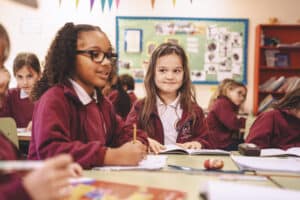
Spanish families researching schools on the Costa del Sol often encounter the British system for the first time. The structure is different from the Spanish one: different terminology, different qualifications, different assessment logic. This guide explains how it works, what to expect at each stage, and how The Benalmádena International College — a British school founded in Benalmádena in 1997 — applies it in practice.
We’ve also covered the specifics of the British curriculum in Spain in a separate post if you want more detail on what makes this approach different from the Spanish national system.
Overview of the British Education System
The British system divides compulsory schooling into blocks called Key Stages, as set out by the UK Government’s national curriculum. Each stage has defined subject content and assessment points. Independent schools like The BIC follow the same framework but have the flexibility to use international versions of qualifications — in our case, Pearson Edexcel IGCSEs and A Levels, which are accepted by universities worldwide.
Main Phases of Education
- Early Years (EYFS): from birth to age 5, pre-compulsory but developmentally critical
- Primary Education: Key Stages 1 and 2, ages 5 to 11
- Secondary Education: Key Stages 3 and 4, ages 11 to 16
- Sixth Form (Key Stage 5): ages 16 to 18, leading to A Levels
- Higher Education: university, from age 18
Key Stages and Age Groups
| Key Stage | Years | Ages | Main milestone |
| EYFS | Preschool – Reception | 3–5 | Good Level of Development |
| KS1 | Years 1–2 | 5–7 | SATs assessment |
| KS2 | Years 3–6 | 7–11 | SATs assessment |
| KS3 | Years 7–9 | 11–14 | Internal assessments |
| KS4 | Years 10–11 | 14–16 | IGCSE / GCSE examinations |
| KS5 | Years 12–13 | 16–18 | A Levels |
Academic and Life Skills: Why the British Approach Is Different
One of the defining features of the British curriculum is that it assesses understanding and application, not just recall. Students are expected to argue positions, evaluate sources, design experiments, and produce original written analysis — particularly from Key Stage 3 onwards. This matters for families considering how their child will be assessed: British qualifications reward students who think independently, not just those who memorise well.
At The BIC, this philosophy runs from Preschool through to Sixth Form, and it’s one of the reasons our students consistently progress to universities in the UK, Europe, and beyond.
Primary Education at The BIC
Primary school covers two Key Stages and spans ages 5 to 11. It’s where children build the academic and social foundations they’ll draw on for everything that follows.
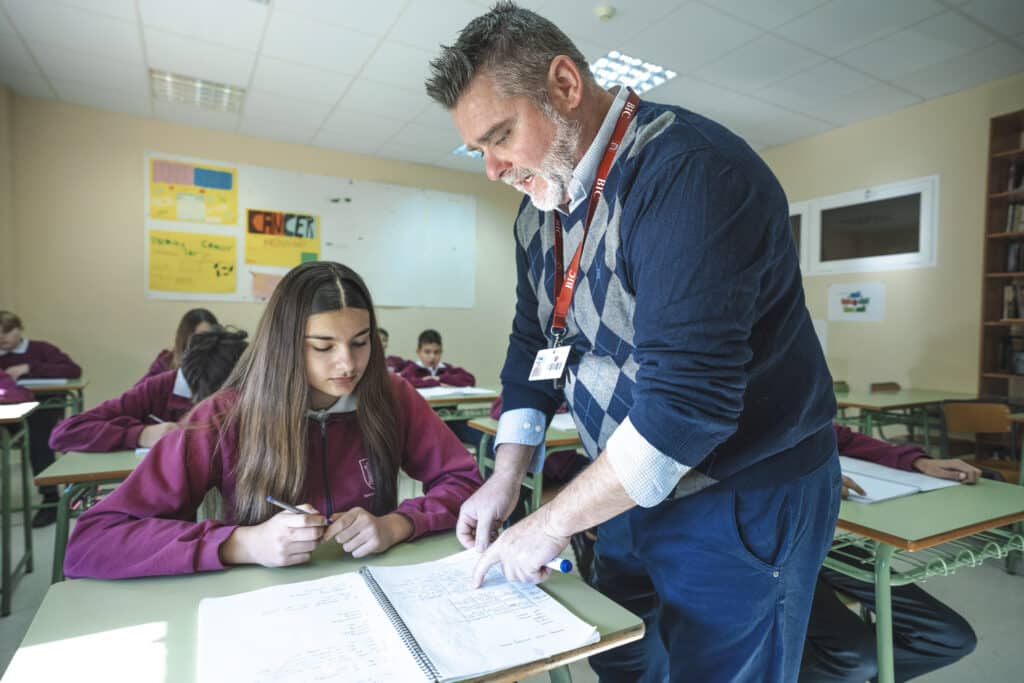
Key Stage 1: The First Years of School (Ages 5–7)
In Years 1 and 2, the focus is on core literacy and numeracy. Children learn to read, write, and work with numbers — but not through drill alone. Practical activities, group work, and play-based learning all have a role in how concepts are introduced and practised.
Core subjects at this stage include English, Maths, and Science, alongside Art, Music, Physical Education, and — at The BIC — Spanish as a modern language from an early age.
At The BIC, the early years are structured around the EYFS framework and Primary methodology developed specifically for this developmental stage.
Key Stage 2: Building Range and Depth (Ages 7–11)
Years 3 to 6 expand the curriculum considerably. Students begin working across a broader range of subjects — History, Geography, Modern Languages, and Computing — alongside the core subjects they’ve been developing since Year 1.
This is also where critical thinking starts to become explicit: students are asked to compare sources, form arguments, and present findings, not just describe what they’ve read.
At the end of Key Stage 2, students take SATs — standardised assessments in Reading, Writing, and Maths. These are used internally to track progress and inform secondary school planning.
Our Primary programme at The BIC is built around the understanding that the skills children develop between 7 and 11 set the tone for how they approach learning throughout secondary school.
Secondary Education: Key Stages 3 and 4
Secondary school runs from Year 7 (age 11) to Year 11 (age 16). The transition from Primary to Secondary is one of the most significant shifts in a child’s school life, and one we support carefully at The BIC.
Key Stage 3: Broadening the Curriculum (Ages 11–14)
Years 7 to 9 are about range. Students continue with core subjects while adding Modern Foreign Languages, Literature, and a wider choice of Science and Humanities content. The pace of written work and independent study increases significantly compared to Primary.
Core subjects at this stage:
- Mathematics, English Language and Literature, Sciences (Biology, Chemistry, Physics)
- History, Geography, and Modern Foreign Languages
- ICT, Physical Education, and the Arts
This stage also matters for subject choices: students begin identifying their strongest areas, which shapes what they take at GCSE/IGCSE in Years 10 and 11.
Key Stage 4: IGCSE Examinations (Ages 14–16)
At The BIC, Key Stage 4 leads to Pearson Edexcel IGCSEs — the international version of GCSEs, designed specifically for students educated outside the UK. These qualifications are accepted by universities in Spain, the UK, and across Europe and are widely regarded as rigorous academic credentials.
We’ve written a detailed post comparing GCSEs vs IGCSEs that’s worth reading if this distinction is new to you.
Students typically sit 8 to 10 IGCSEs across a range of subjects. The results feed directly into Sixth Form subject choices — and, ultimately, university applications.
Our full Secondary programme is described in more detail on the corresponding page.
Sixth Form: A Levels and University Preparation
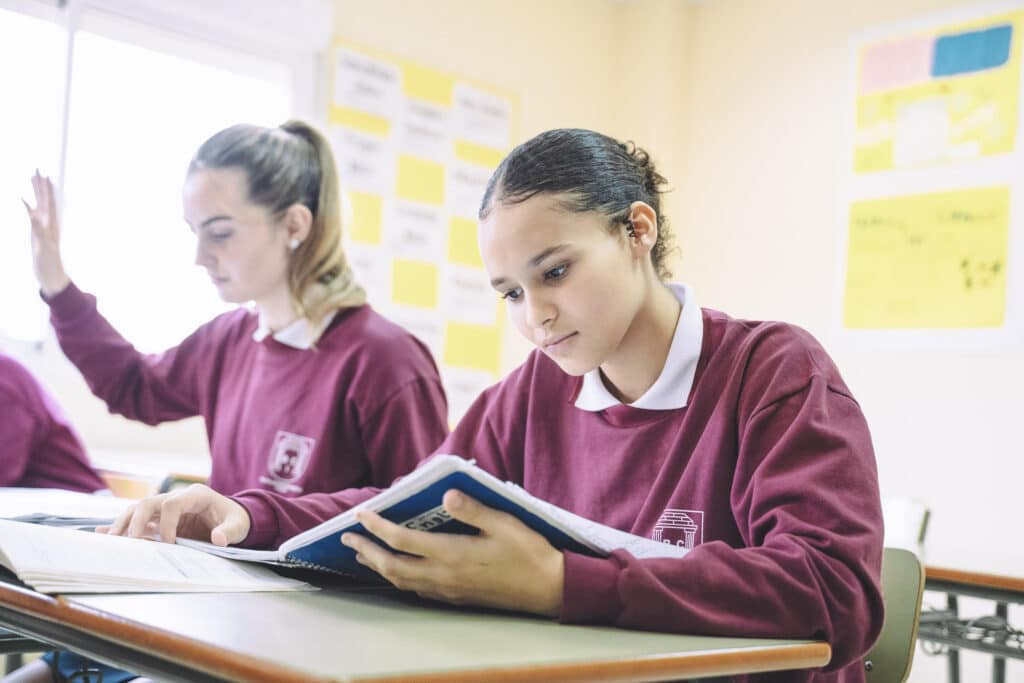
Sixth Form covers Years 12 and 13, from age 16 to 18. Students choose 3 to 4 subjects to study in depth over two years, culminating in A Level examinations.
A Levels: The British University Entrance Qualification
A Levels are the main university entrance qualification in the British system. Students choose subjects that align with their intended field of study — typically three A Levels, though some choose four. The subjects taken matter: a student aiming for Medicine will usually need Biology, Chemistry, and either Maths or Psychology; one aiming for Law might take History, English Literature, and Politics.
At The BIC, Sixth Form students follow the Pearson Edexcel A Level programme — the same qualification system used for IGCSEs, which means students and teachers know the assessment style well before Sixth Form begins.
Subject Selection and University Preparation
Choosing A Level subjects is one of the most consequential decisions in the British system, and it comes at 16 — earlier than most Spanish families expect. At The BIC, students receive structured guidance throughout Key Stage 4 to help them make informed choices.
We’ve written in detail about how we prepare students for universities in the UK and Europe — from personal statement support to university fair attendance.
A Levels: Global Recognition
A Levels are accepted by universities across the UK, continental Europe, North America, and beyond. For Spanish families, it’s worth knowing that Spanish universities also recognise A Levels as a university access qualification — though the equivalency process has specific requirements. Our Sixth Form team can advise on this directly.

Higher Education and University Admissions
A Level results are the primary criterion for UK university admissions. Applications go through UCAS — the UK’s centralised university admissions service — typically submitted during Year 13 for entry the following autumn.
The Role of A Level Results
Universities set conditional offers based on expected A Level grades. A student might receive an offer of AAB from a particular institution — meaning they need those results to secure their place. Results day in August is therefore a significant moment in the British academic calendar.
Strong A Level results open doors to universities like Oxford, Cambridge, Imperial College London, and University College London. The BIC’s track record in university admissions reflects years of focused Sixth Form preparation.
British Qualifications: International Standing
British qualifications — GCSEs, IGCSEs, and A Levels — are recognised by universities and employers worldwide. The Independent Schools Inspectorate (ISI), which inspects and accredits The BIC, applies the same rigorous standards used across the UK independent school sector. This accreditation matters because it means The BIC’s qualifications carry the same weight as those from schools in England or Wales.
Types of Schools in the British Education System
For families new to the British system, the range of school types can be confusing. A brief orientation:
State schools follow the national curriculum and are funded by the government. They are free to attend but are generally only accessible to local residents.
Grammar schools are selective state schools — entry requires passing the 11+ exam. They typically have strong academic results but limited places.
Independent schools charge fees and have flexibility over curriculum design. They often use international qualifications like IGCSEs rather than standard GCSEs. Class sizes tend to be smaller, and the range of extracurricular provision is typically broader. The BIC is an independent school.
International schools — which The BIC is — combine the British curriculum with a multilingual, multicultural environment designed for families from multiple nationalities. The teaching approach reflects the British system, but the school community is international by design.

Curriculum and Assessment Structure
The British curriculum assesses students through a combination of ongoing coursework and end-of-year or end-of-course examinations. The balance varies by subject and Key Stage.
Balancing Academic Content and Practical Skills
The British curriculum is explicit that academic knowledge and applied skills are both assessed. A student who understands a concept but cannot explain it clearly, use it in an unfamiliar context, or argue for it in writing will not achieve top marks. This shapes how teachers at The BIC approach instruction — not just covering content, but ensuring students can work with it independently.
Ongoing Assessment vs Final Examinations
At Key Stage 4 and Sixth Form, most subjects combine coursework (typically 20–30% of the final grade) with written examinations. At Key Stage 2, SATs are standardised national assessments that provide a snapshot of progress in core subjects.
SATs in Key Stages 1 and 2
SATs are taken at the end of Year 2 (KS1) and Year 6 (KS2). They assess Reading, Writing, and Mathematics. The results are used by parents and teachers to understand where a student is performing relative to national expectations — they don’t determine secondary school entry, but they do inform the support and planning that follows.
Preparing Students for Critical Thinking
From Key Stage 3 onwards, the British curriculum explicitly asks students to analyse, evaluate, and argue. Essay writing, scientific investigation, and source analysis are all built into standard subject requirements. Students who develop these skills in their secondary years are considerably better prepared for the independent study demands of A Levels and university.
Support for Students at The BIC
The BIC has students from 33 nationalities. That’s not unusual for an international school, but it does mean the teaching team is experienced in supporting children who may be joining mid-year, learning in a language that isn’t their first, or navigating a very different academic system from the one they knew previously.
Personalised Learning
Every student at The BIC follows a curriculum path suited to their stage and level. Where extra support is needed — whether academic, linguistic, or pastoral — it’s built into the school week rather than bolted on. Specific provision includes:
- Individual academic mentoring for students with identified gaps
- Language support for students transitioning into English-medium education
- Flexible pathways that reflect individual strengths and interests

Social and Emotional Development
Academic results matter. So does the environment in which students achieve them. At The BIC, our approach to safeguarding and wellbeing means students have access to pastoral support throughout their time at school — not just at moments of crisis, but as a consistent part of school life.
Group activities, student-led projects, and structured dialogue are all part of how social skills are developed alongside academic ones. Students who know how to work with others, manage disagreement, and communicate under pressure are better prepared for both university and work.
Extracurricular Activities
Learning doesn’t stop when lessons end. The BIC’s extracurricular activities programme includes team sports, arts, coding, and STEM clubs — each contributing to the broader skill development that British universities and employers look for beyond exam results.
Frequently Asked Questions About the British Education System
Which Key Stage corresponds to my child’s age? EYFS covers ages 3 to 5. KS1 runs from 5 to 7, KS2 from 7 to 11, KS3 from 11 to 14, KS4 from 14 to 16, and KS5 (Sixth Form) from 16 to 18. If you’re unsure which year group your child would enter, our admissions team can advise based on your child’s current age and educational background.
What is the difference between GCSEs and IGCSEs? IGCSEs are the international version of GCSEs, designed for students studying outside the UK. They cover the same subject content but are set and marked specifically for an international cohort. The BIC uses Pearson Edexcel IGCSEs throughout Key Stage 4. We cover the differences in detail in our post on GCSEs vs IGCSEs.
Are British qualifications recognised in Spain for university access? Yes. IGCSEs and A Levels are recognised internationally, including for access to Spanish universities, though the homologation process has specific requirements. Spanish families should confirm the current requirements with the relevant Spanish authority and consult The BIC’s Sixth Form team for school-specific guidance.
How do students choose their A Level subjects? Subject selection happens at the end of Year 11, following IGCSE results. At The BIC, students receive guidance from their subject teachers and the Sixth Form coordinator well before this point — usually from Year 10 — to help them think clearly about which subjects align with their university ambitions. More detail is available in our post on Pearson Edexcel A Levels in Spain.
How does The BIC support students who haven’t studied the British curriculum before? Students joining from the Spanish system or other international curricula receive an initial academic assessment, and where needed, additional language or subject support is provided. The BIC has been doing this for students from 33 nationalities since 1997 — structured transition support is part of how the school operates, not an exception. The step-by-step admissions process explains how this works in practice.
Why Choose The BIC
The British system is available at several schools on the Costa del Sol. What distinguishes The BIC comes down to a few specific things.
The school has been in Benalmádena since 1997 — long enough to have a real track record in university admissions, ISI accreditation, and student outcomes. The campus covers 17,500 m², with facilities designed to support the full range of academic and extracurricular activity the British curriculum demands.
The student body represents 33 nationalities — which means children develop cross-cultural communication skills as a natural consequence of daily school life, not as a curriculum add-on. For families relocating to Spain or already established on the Costa del Sol, that environment tends to make the transition easier, not harder.
And because the school runs entirely through Pearson Edexcel — from EYFS through to A Levels — students, parents, and teachers work within a consistent qualification framework from start to finish.
If you’d like to visit and see the school in person, we’d be glad to arrange it.