

By 2030, most of the jobs today’s primary school children will hold don’t yet exist. That’s not a reason to panic — it’s a reason to think carefully about what we’re actually teaching. According to the World Economic Forum’s Future of Jobs Report, creativity, critical thinking, and digital literacy have overtaken many traditional academic competencies in employer rankings. At The Benalmádena International College, a British school on the Costa del Sol, this has shaped how we approach learning from the earliest years.
Understanding the Importance of Future Skills for Children
The World Economic Forum’s Future of Jobs Report makes the direction of travel clear: the competencies employers are prioritising for the coming decade are shifting, and schools that don’t adapt their approach will leave students underprepared — not for lack of knowledge, but for lack of the right habits of thinking.
Why Future Skills Matter in Today’s World
A child who memorises well but struggles to reason independently, collaborate, or adapt will find things difficult — not just in competitive university applications, but in most situations adult life throws at them. The jobs that reward recall alone are shrinking. The ones that remain need people who can think across disciplines, work alongside others who see things differently, and change course when a plan stops working.
Three things stand out:
- The changing nature of work demands creativity, critical thinking, and the ability to work across cultures.
- Digital literacy now underpins virtually every career path, not just technical ones.
- Emotional intelligence determines how well people build relationships, lead others, and get through disagreement productively.
How Developing Future Skills Supports Children’s Growth
Children who build these skills early don’t just perform better academically — they’re more engaged, more resilient when things go wrong, and more comfortable working alongside people from different backgrounds. The effect compounds: habits of thinking formed at seven make a real difference at seventeen.
At The BIC, this runs through every stage of schooling — from the earliest years in our Preschool programme through toPrimary and beyond.
The Role of Education in Shaping Future Generations
What distinguishes schools that prepare children well from those that don’t usually isn’t about facilities or resources. It’s whether the daily experience of learning is active or passive — whether children are solving real problems or working through content they’ll forget by the weekend.
Three approaches have a clear track record:
- Project-based learning develops creativity and teamwork through problems worth actually solving.
- Technology integration builds digital fluency alongside the judgment to know when and why to use it.
Key Skills Children Need to Develop Early
Some skills compound earlier than others. The ones below, introduced in the first years of school, tend to reinforce everything that follows.
1. Creativity and Thinking Outside the Box
Creativity is not a personality trait. It is a practised skill — one that gets better with use, like any other. A student who approaches a maths problem from several directions is being creative. So is one who spots a flaw in an argument, or finds an unexpected angle on a history essay.
Activities that build it:
- Open-ended art and design projects that reward original decisions, not just clean execution.
- Collaborative storytelling and creative writing with genuine constraints.
- Design challenges that require iteration: build, test, change, try again.
We’ve written about this in more detail in our post on fostering creativity in children.

The Link Between Creative Thinking and Problem Solving
A student who only knows one method for solving a problem is stuck the moment that method doesn’t apply. Creative thinking gives children more routes through. It also makes them more comfortable with ambiguity — a quality that matters considerably once they leave formal education and face problems that don’t come with answer keys.
2. Communication and Social Skills
Being able to articulate an idea clearly — in writing, in a presentation, or across a table — is one of the most practical things a child can learn. So is listening properly, reading a room, and adjusting tone depending on who you’re talking to.
Developing effective communication:
- Role-play and drama to practise verbal and non-verbal expression in low-stakes situations.
- Structured group discussions and age-appropriate debates.
- Regular feedback cycles where students both give and receive critique, which is harder than it sounds.
Building Emotional Intelligence in the Early Years
Emotional intelligence — the ability to understand your own reactions and empathise with someone else’s — turns out to be a better predictor of long-term success than cognitive ability alone. That’s not an argument against academic rigour; it’s an argument for taking both seriously.
At The BIC, our commitment to safeguarding and wellbeing is built around giving children the psychological safety to understand and express what they feel without being judged for it. That’s a prerequisite for genuine emotional development — not a nice-to-have.
Social Skills for Collaborative Learning
There are students from 33 nationalities at The BIC. That diversity means children have to navigate different communication styles and perspectives every single day — not as a lesson topic, but as lived experience. Those who do it well will find those same skills useful anywhere they go.
3. Critical Thinking and Problem Solving
Critical thinking is the ability to examine information, question its source, spot weak reasoning, and reach a conclusion that can survive scrutiny. It matters more now than it did twenty years ago, in a world where unreliable information travels faster than corrections.
Teaching children to analyse and evaluate:
- Logic games, puzzles, and Socratic questioning built into everyday classroom practice.
- Science experiments where hypotheses are tested against evidence, not assumed to be correct.
- Debates where students are required to argue positions they didn’t start with.
Practical Approaches to Problem Solving
The gap between knowing something and being able to use it is significant. At The BIC, students regularly work through active learning approaches where they define a problem, propose solutions, act on them, and then look critically at what happened — which is closer to how adults actually operate.
4. Digital Literacy and Safe Technology Use
Digital literacy is not about being good with devices. It’s about knowing how to evaluate what you find online, understanding how your data is used, creating things with technology, and thinking clearly about the role algorithms play in shaping what you see and believe.
What this looks like at The BIC:
- Digital tools used in lessons to deepen understanding, not replace it.
- Direct teaching on digital citizenship, online privacy, and responsible behaviour.
- Coding and multimedia projects that build computational thinking from a young age.
We covered this in our post on the impact of educational technology in private schools.
Introducing Children to Artificial Intelligence
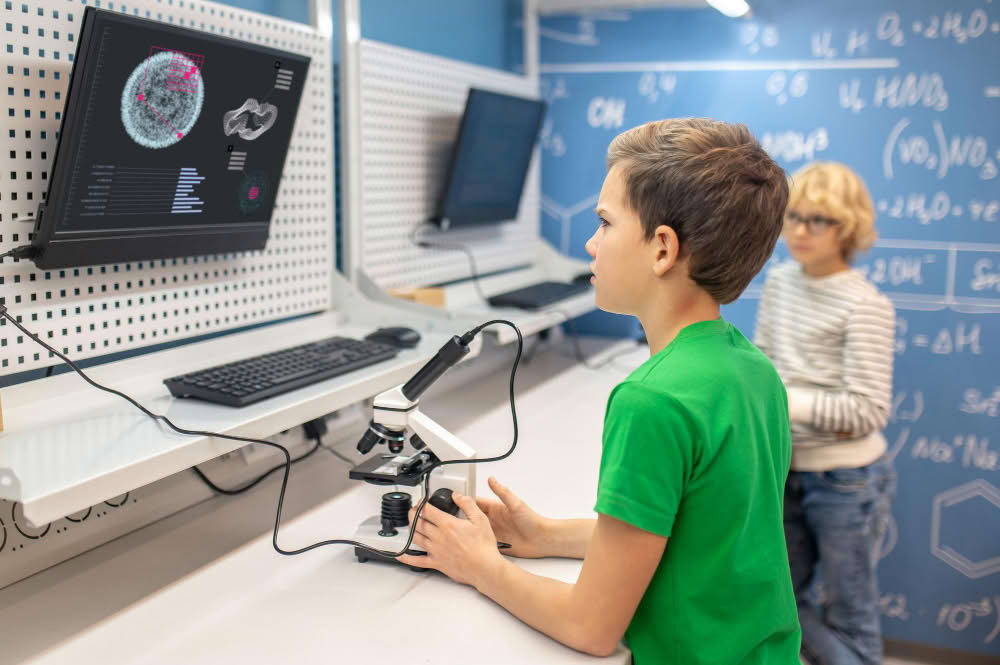
AI is not going away. Children who understand what it is, what it can and can’t do, and how to work alongside it will be better placed than those who don’t. At The BIC, technology sits within the broader curriculum framework as something to think with — not as a shortcut around thinking.
5. Adaptability and Growth Mindset
Of all the skills on this list, the ability to adapt is probably the one that will matter most over a lifetime — because the conditions keep changing. The concept of growth mindset, developed by psychologist Carol Dweck, captures something real: children who believe their abilities grow through effort approach difficulty differently from those who believe their abilities are fixed.
Building resilience and flexibility:
- Giving children problems slightly beyond their current level, and making that feel normal rather than threatening.
- Treating mistakes as information rather than evidence of failure.
- Focusing feedback on effort and approach, not just outcomes.
Self-Reflection as a Learning Tool
Children who regularly review their own work — what they understood, what they missed, what they’d do differently — build stronger thinking habits over time. This becomes more useful, not less, as they move through school and take on more independent responsibility.
Methods and Activities That Develop Future Skills at The BIC
Knowing which skills matter is one thing. The harder question is how to build them, consistently, across different age groups and learning styles.
Experiential and Project-Based Learning
When students work on problems with no single correct answer — designing something, investigating a real issue, producing work for an actual audience — they develop multiple skills at once. Students remember more, engage more, and transfer knowledge more readily when they’re active participants rather than recipients.
At The BIC, project-based learning runs through the curriculum from the earliest stages in Preschool through to Primary and Secondary. This is part of what has earned The BIC recognition from bodies including the Independent Schools Inspectorate (ISI).
Outdoor Activities That Foster Critical Thinking
Some of the most useful thinking happens outside the classroom. Fieldwork, environmental investigations, and team activities all require children to observe carefully, make decisions with incomplete information, and adjust when things don’t go as expected. Our post on environmental activities for children covers several of the approaches we use.
The school’s facilities — 17,500 m² of campus in Benalmádena Costa — give us the physical space to make outdoor and experiential learning a regular part of the week.
Collaborative Learning and Teamwork
Working in groups teaches things individual study can’t: how to contribute when you’re not in charge, how to push back on an idea without damaging a relationship, how to get something finished when the team doesn’t fully agree. These are useful skills in most workplaces and most families.
Students at The BIC build them through team sports, cross-subject projects, and cross-year activities where older and younger students work together. Our extracurricular activities programme extends this further — from STEM clubs and coding to music, arts, and competitive sport.
Technology as a Learning Tool
The risk with technology in schools is that it becomes a replacement for thinking rather than a vehicle for it. At The BIC, we’re deliberate about the difference. Digital platforms are used to deepen understanding. Students work on digital design and video production alongside their core subjects. All of it sits within the Pearson Edexcel framework — a British curriculum that rewards independent thought and applied understanding.

Creativity Through Arts and Play
Structured play and artistic work are not optional extras. They are where children take risks with ideas, try things that might not work, and build the confidence to make and defend an original decision. At every stage of schooling, The BIC builds in space for this kind of thinking.
How Parents Can Support Future Skill Development at Home
School provides the structure, but parents remain the most consistent influence in a child’s development. A few things make a real difference:
Creating Learning Opportunities at Home
- Cooking together — measurement, sequencing, improvisation when something runs out, and the occasional mess.
- Reading aloud — especially stories with real dialogue and moral complexity — builds language, imagination, and emotional vocabulary faster than most formal exercises.
- Giving children real responsibilities — routines that require planning, persistence, and some genuine accountability.
Encouraging Critical Thinking and Creativity
Ask questions that don’t have a single answer. “What was the most interesting thing that happened today?” is more useful than “Did you have a good day?” Encourage children to argue for a position before changing their mind — not because stubbornness is a virtue, but because forming and defending a view is a skill worth practising.
Unstructured time matters more than most schedules allow. Some of the most original thinking happens when children aren’t being directed.
Supporting Emotional Awareness
A home where all emotions are acceptable — including the difficult ones — gives children a safe place to practise naming what they feel and working out what to do with it. Role-playing situations helps too: “what would you do if a friend was upset with you at break time?” gives children a chance to think through social dynamics before they face them under pressure.
Building Perseverance and Work Ethic
Praise effort and approach, not just results. A child who worked hard and got it wrong learned more than one who got it right without trying. When something goes wrong, “what could we do differently?” is a better question than “why did that happen?” The first invites problem-solving. The second invites defensiveness.
Preparing Children to Become Global Citizens
The world children will work and live in is international. The ability to collaborate with people from different countries, backgrounds, and ways of thinking is a practical requirement in most careers and most cities — not a soft skill.
Developing Global Awareness and Responsibility
Teaching children about climate change, economic inequality, and geopolitical complexity is not pessimism. It’s preparation. Students who understand the actual challenges the world faces tend to approach their own education differently — with a clearer sense of what any of it is for.
The BIC integrates current-affairs discussions and cross-disciplinary projects that connect what students study to what’s happening. Participation in community and environmental initiatives adds a practical dimension to this awareness.
The Importance of Cross-Cultural Communication
The BIC’s community spans over 33 countries. Children don’t just read about cultural difference — they navigate it with their classmates every day. The communication skills this builds over years are different from anything you can teach in a single lesson.
We’ve written about the evidence behind this in our post on the advantages of cultural exchange for students.
Multicultural Learning at The Benalmádena International College
Throughout the year, students at The BIC take part in international events, language programmes, and collaborative projects that cross cultural lines. The school’s commitment to bilingual and multilingual education adds linguistic range to this — and OECD research consistently shows that bilingual students score higher on measures of cognitive flexibility and academic performance across subjects.

Activities That Promote Understanding of Different Perspectives
Intercultural festivals, guest speakers from different professional and national backgrounds, and structured discussion of global issues give students repeated, concrete exposure to perspectives other than their own. Over time, this shapes how they listen — not just how they speak.
Frequently Asked Questions About Future Skills in Children
What are the most important future skills for children to develop? The World Economic Forum puts creativity, critical thinking, emotional intelligence, digital literacy, and adaptability at the top of the list. At The BIC, all five are built into the British curriculum from Preschool onwards — progressively, so children develop them across years rather than encountering them late.
At what age should children start developing future skills? Earlier than most people assume. Social-emotional learning and creative thinking start to matter in the first years of school, which is why our EYFS and Primary methodology is structured specifically around this developmental window.
How does a British curriculum school prepare children for the future? The Pearson Edexcel framework The BIC follows puts a strong emphasis on critical thinking, independent research, and applied problem-solving — particularly at IGCSE and A Level. Unlike systems built primarily on recall, the British curriculum rewards students who can analyse, argue, and think originally.
How can parents tell if their child is developing the right skills? Look beyond grades. A child who attempts challenging tasks without being pushed, bounces back from setbacks, asks questions out of genuine curiosity, and can hold and defend a position is developing well — whether or not that’s immediately visible on a report card.
Does The BIC offer extracurricular activities that develop future skills? Yes. The BIC’s extracurricular activities programme runs from STEM and coding clubs to team sports, arts, and performance — each of which builds skills the classroom alone can’t replicate.
Find Out More About The BIC
If you’re looking for a school on the Costa del Sol where academic rigour and genuine child development go together, we’d be glad to show you around.